


ISO 9001:2026 for Auditors: Key Changes and Transition Dates
ISO 9001:2026 was published on 16 September 2026. The 5 key changes, what auditors look for, the transition dates to 2029 and which training fits your role.
Eren İŞMAN · Lead Trainer, MEGADEMİ
Türkçe okuISO 9001:2026 is the new edition of the quality management system standard. ISO published it on 16 September 2026, and it replaces ISO 9001:2015. The clause structure is unchanged. The new edition puts more weight on leadership, quality culture and ethical behaviour, separates risks from opportunities more clearly, and adds an explanatory Annex A. Certified organizations must complete their transition, including issue of the new certificate, before 30 September 2029.
This guide is written for auditors. It explains what changed, what an auditor will look for in practice, the official transition dates, and which training route fits your role.
Key takeaways
- Published: ISO 9001:2026 was published on 16 September 2026 and replaces ISO 9001:2015, including its 2024 climate change amendment.
- Five headline changes: leadership and quality culture (clause 5.1), quality policy linked to strategy (5.2), a clearer distinction between risks and opportunities (6.1), awareness of quality culture and ethical behaviour (7.3), and a new explanatory Annex A.
- Structure kept: the standard keeps the Harmonized Structure, so existing systems and integrated audits remain familiar.
- Deadlines: after 31 March 2028, no new ISO 9001:2015 certificates may be issued; accredited ISO 9001:2015 certifications are no longer valid after 30 September 2029.
- Auditors: certification bodies must ensure their auditors are trained and competent for the new edition; personnel certification bodies set their own transition rules.
What is ISO 9001:2026?
ISO 9001:2026 is the sixth edition of ISO 9001, the international standard that specifies requirements for a quality management system (QMS). It was developed by ISO/TC 176/SC 2 and announced by ISO on 16 September 2026 (ISO). According to ISO, the revision does not introduce a fundamentally new approach; it strengthens existing requirements and clarifies their intent. Customer focus, the process approach, risk-based thinking and continual improvement remain at the heart of the standard (ISO).
Two related standards are also new. ISO 9000, the fundamentals and vocabulary standard, has a 2026 edition (ISO). ISO 19011:2026, the guidelines for auditing management systems, has also been published (ISO).
What changed in ISO 9001:2026? The five headline changes
ISO lists five main changes. The table pairs each change with the kind of evidence an auditor can expect to examine.
| Change | Clause | What auditors are likely to examine (practical guidance) |
|---|---|---|
| Stronger role for leadership: quality culture and ethical behaviour | 5.1 | How top management promotes quality culture and ethical behaviour, and how that is visible in decisions, communication and follow-up |
| Quality policy linked to context and strategic direction | 5.2 | Whether the quality policy is consistent with the organization's context and strategy, and how it informs quality objectives |
| Clearer distinction between risks and opportunities | 6.1 | Whether risks and opportunities are identified and acted on as separate inputs to planning, and how actions are evaluated |
| Greater emphasis on people: awareness of quality culture and ethics | 7.3 | Whether people understand the quality culture and ethical behaviour expected of them, typically through interviews at different levels |
| New Annex A explaining concepts and intent | Annex A | Helps the audit team interpret the requirements consistently |
Alongside these, ISO notes smaller refinements reflecting digitalization, organizational knowledge, complex supply chains and resilience (ISO).

What stayed the same?
- Clause structure: ISO 9001:2026 retains the Harmonized Structure used across ISO management system standards, which helps integrated audits with ISO 14001 or ISO 45001.
- Core principles: customer focus, the process approach, risk-based thinking and continual improvement.
- Climate change: the consideration of climate change added to ISO 9001:2015 by the 2024 amendment is carried forward.
- Voluntary certification: certification to ISO 9001 remains voluntary (ISO).
ISO 9001:2026 transition timeline: the official deadlines
The certification transition is set by Global ACI (Global Accreditation Cooperation Incorporated). Its transition requirements for ISO 9001:2026 give a three-year transition period, counted from the last day of the publication month (Global ACI).
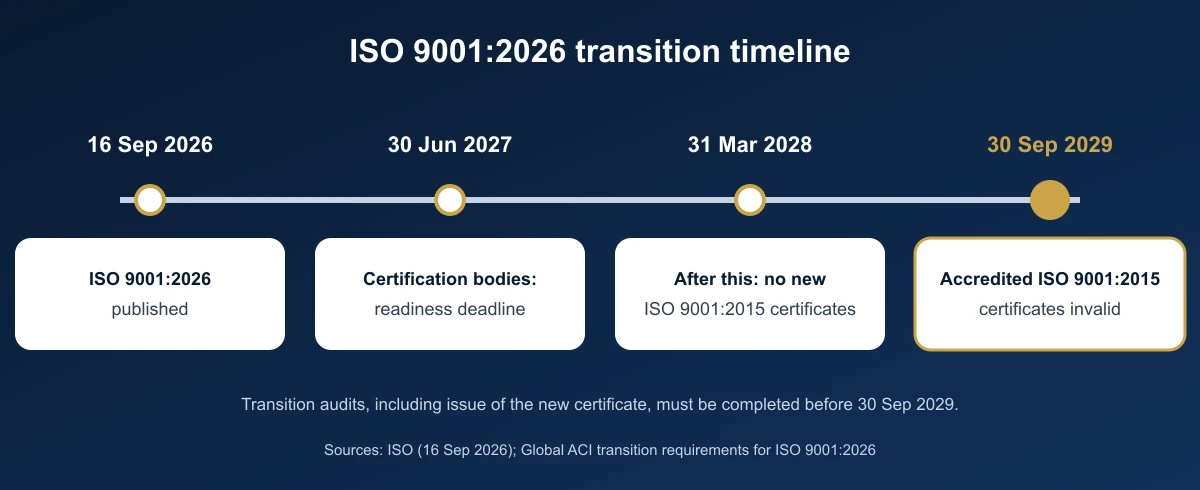
| Date | Milestone |
|---|---|
| 16 September 2026 | ISO 9001:2026 published |
| 30 June 2027 | Deadline for accredited certification bodies to declare their readiness to their accreditation body |
| 31 March 2028 | After this date, new (initial) certifications only to ISO 9001:2026; no new ISO 9001:2015 certificates |
| 30 September 2029 | Accredited ISO 9001:2015 certifications are no longer valid; transitions, including certificate issue, must be completed before this date |
Certified organizations move to the new edition through a scheduled surveillance or recertification audit, or a special transition audit. When deciding whether extra audit time is needed, the certification body considers, at a minimum, the degree of change to the client's system and whether the transition is combined with an annual audit or done as a special audit (Global ACI).
What the transition means for auditors
The transition affects different auditors in different ways:
- Certification body auditors. Global ACI requires certification bodies to ensure that relevant personnel affected by the change are trained and competent for the revised version. Relevant personnel may include, for example, auditors, technical reviewers and decision makers (Global ACI).
- Certified (personnel) auditors. If you hold a QMS auditor certification, your personnel certification body sets the transition rules. Exemplar Global builds certification programs for auditors, trainers and certification bodies. It has consulted on updated QMS auditor certification requirements for ISO 9001:2026 (PCD21, Edition 4). As of 16 October 2026, the consultation has closed and the final version is still to be published (Exemplar Global). Check your certification body before planning training.
- Internal auditors. Update internal audit programmes, checklists and auditor briefings to the 2026 clauses, especially 5.1, 5.2, 6.1 and 7.3, before the organization's transition audit.
Illustrative example: a supplier quality engineer who has led ISO 9001:2015 supplier audits does not need to relearn auditing. The engineer needs to understand the changed requirements and update audit checklists so that interviews cover quality culture and ethical behaviour (5.1, 7.3) and so that risks and opportunities are sampled separately (6.1). This example is for illustration only and is not a real client case.

Which ISO 9001:2026 training do you need?
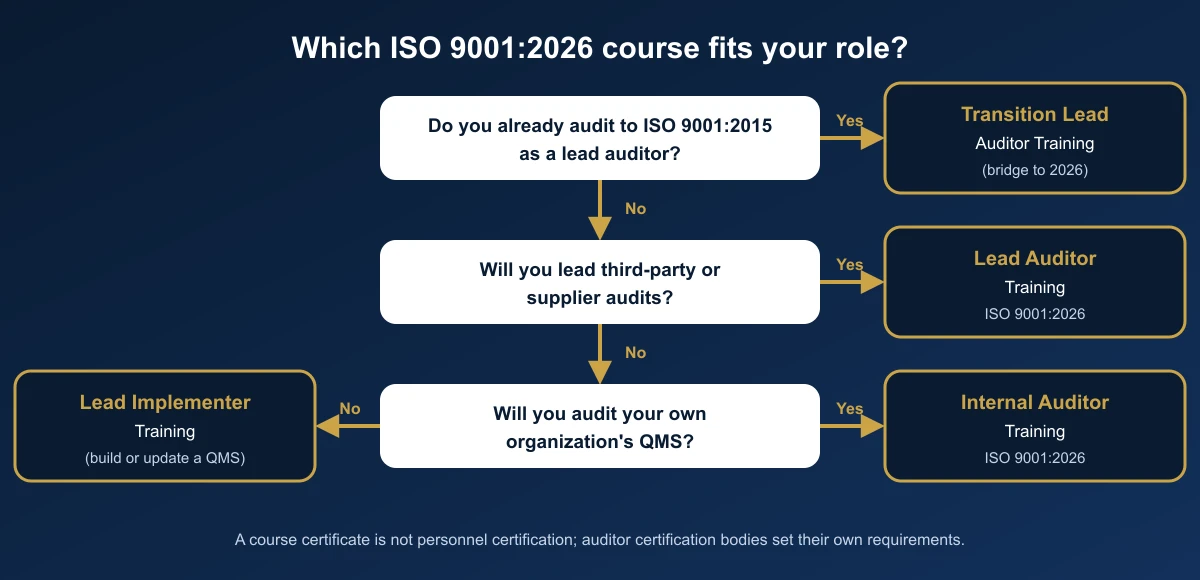
| Training | Who it is for | Typical outcome |
|---|---|---|
| Transition Lead Auditor | Lead auditors who already audit to ISO 9001:2015 | Understanding of the changes and how to audit them |
| Lead Auditor | People who will plan and lead audits, including third-party and supplier audits | Ability to plan, conduct, report and lead audits following ISO 19011:2026 guidance |
| Internal Auditor | Staff who audit their own organization's QMS | Ability to plan and carry out internal audits |
| Lead Implementer | Quality managers and consultants who build or update a QMS | Ability to implement and transition a QMS |
MEGADEMİ's ISO 9001:2026 Lead Auditor, Transition Lead Auditor, Lead Implementer and Internal Auditor courses are listed as Recognized Training Provider (RTP) courses in Exemplar Global's register, under the company name MEGADEMI-EUROTECH LLC (Exemplar Global register). A course certificate shows that you completed a course, and passed its assessment where the course has one; it is not a personnel certification as an auditor.

If you are new to third-party auditing, the ISO 9001:2026 Lead Auditor Training covers planning, conducting and leading audits. Staff who audit their own organization can start with the ISO 9001:2026 Internal Auditor Training, and quality managers updating their system can take the ISO 9001:2026 Lead Implementer Training. The full list is on the ISO 9001 training page; for team training, see corporate ISO training. If you are still choosing a career path, our guide on how to become a lead auditor explains the steps.
A five-step transition checklist for audit teams
- Read the new edition and Annex A. Annex A explains intent and helps the team interpret requirements consistently.
- Map the changes. Compare ISO 9001:2015 and ISO 9001:2026 clause by clause and mark changed requirements in your checklists.
- Update audit tools. Add interview prompts for quality culture and ethical behaviour (5.1, 7.3), and sample risks and opportunities separately (6.1).
- Close competence gaps. Plan transition training for lead auditors who already audit to ISO 9001:2015, and brief internal auditors on the changed clauses.
- Align with the certification timeline. Agree the transition audit with your certification body so that the audit and the new certificate are completed before 30 September 2029. After 31 March 2028, initial certifications are to ISO 9001:2026 only.
Frequently asked questions
When was ISO 9001:2026 published?
ISO published ISO 9001:2026 on 16 September 2026. It replaces ISO 9001:2015, including its 2024 amendment on climate change.
Is ISO 9001:2015 still valid?
ISO 9001:2015 has been replaced by ISO 9001:2026. Accredited ISO 9001:2015 certifications remain valid during the transition but are no longer valid after 30 September 2029. After 31 March 2028, no new ISO 9001:2015 certificates may be issued.
Do organizations need to rebuild their quality management system?
No. ISO advises organizations to build on their existing systems and processes, keeping what works and making targeted changes where needed. The clause structure is unchanged.
Do certified auditors need new training for ISO 9001:2026?
It depends on your personnel certification body. Separately, accredited certification bodies, which certify organizations, must ensure their own auditors are competent for the new edition. Exemplar Global's updated QMS requirements for ISO 9001:2026 had not been finalized as of 16 October 2026.
What auditors should do next
ISO 9001:2026 refines ISO 9001:2015 rather than replacing its approach. For auditors, the practical work has three parts. First, understand the five changes. Second, update audit tools for leadership, quality culture, ethics and the clearer distinction between risks and opportunities. Third, plan training around two dates: 31 March 2028, after which initial certifications are to ISO 9001:2026 only, and 30 September 2029, the end of the transition. To choose a course for your role, start with the decision tree above or contact us for advice on individual or team training.
About this guide
- Author: Eren İŞMAN, Lead Trainer, MEGADEMİ; mechanical engineer and lead auditor with more than 25 years of experience.
- Method: prepared with AI assistance; the photo-style images, including the cover, are AI-generated and illustrative; facts were checked against the ISO, Global ACI and Exemplar Global sources listed below. This is general guidance; audit against the published standard and your certification body's rules. Last reviewed: 16 October 2026.
- Disclosure: MEGADEMİ provides ISO auditor training, including the courses mentioned in this article.
Sources
- ISO launches update to world's most widely used quality management standard for a new era of business, ISO press release, 16 September 2026.
- ISO 9001:2026: What businesses need to know, ISO.
- ISO 9001:2026 Quality management systems — Requirements, ISO.
- Global ACI transition requirements for ISO 9001:2026, Global ACI.
- ISO 9001:2026 PCD21 Certification Requirements Edition 4, Exemplar Global.
- Training provider register entry: MEGADEMI-EUROTECH LLC, Exemplar Global.